Examples
Watch the checks turn progress into credit
An agent works on a phone task turn by turn. After every turn, the task’s acceptance checks run again on the new state. When the attempt ends, compare the credit GRPO and ProCredit give each turn.
Alarms
Device state updates after each tool return.
Credit per turn after the attempt ends
made more likelymade less likely
Method
Progress is as verifiable as the outcome
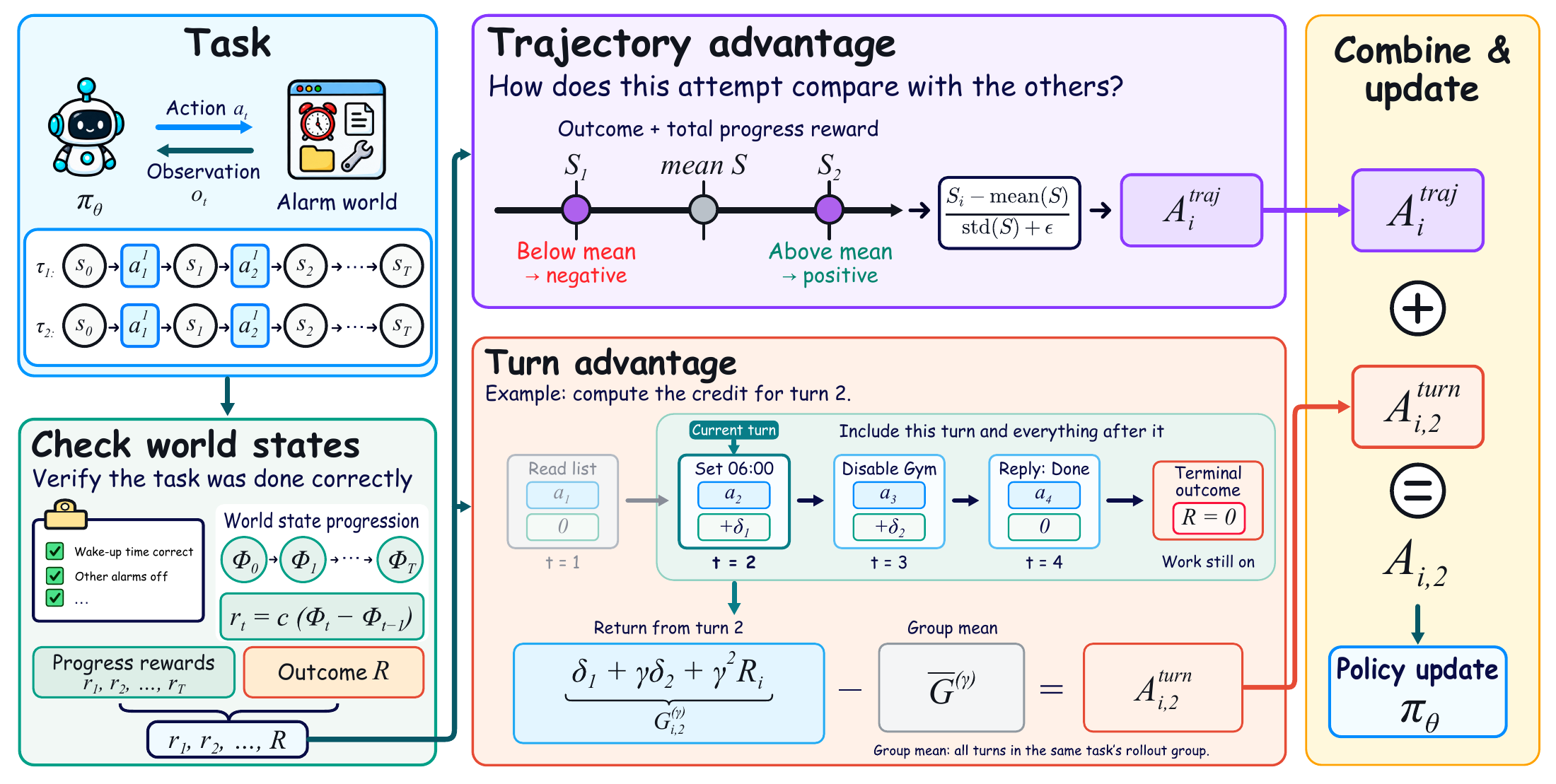
The checks that decide whether a task succeeded can also run on every intermediate state. ProCredit uses them three ways.
-
1
Check progress after every turn
Φt = passed checks / K
Rerun the task’s K acceptance checks on the new environment state. A query leaves progress unchanged; a wrong change can lower it.
-
2
Reward the change
rt = c (Φt − Φt−1)
The attempt’s score adds its progress rewards to the outcome, S = R + c ΦT. A success still outscores every failure.
-
3
Credit at two levels
Ai,t = Aitraj + Ai,tturn
Compare scores across attempts at the same task, then tilt credit within an attempt by the return still to be earned from each turn.
Performance
Results on AppWorld
Qwen3.5 base models at three sizes, trained on AppWorld. Mean ± standard deviation over 3 training runs.
TGC: task goal completion. SGC: scenario goal completion, where every task in a scenario must succeed. Axes start above zero so the differences are visible; bars share one scale within each metric. 35B is Qwen3.5-35B-A3B. GiGPO uses its default γ = 0.95.
Citation
@article{ma2026procredit,
  title   = {ProCredit: From Outcome Rewards to Progress Credit
             in Agentic Reinforcement Learning},
  author  = {Ma, Ming and Zhu, Yi and Zhong, Yiran and Zhu, Feida and
             Liu, Chonghan and Jiao, Pengkun and Wang, Qichao and
             Jia, Yanhao and Yang, Tianming and Hoi, Steven},
  journal = {arXiv preprint arXiv:2609.27532},
  year    = {2026},
  url     = {https://arxiv.org/abs/2609.27532}
}